
NBA betting terminology in the UK is a collision of two vocabularies. American sports betting language – spread, parlay, juice, vig – sits alongside British gambling terms like accumulator, handicap, and punter. If you have ever read an NBA betting guide written for a US audience and felt like half the terms needed translating, this glossary exists for you. Every definition below is written in UK context, with decimal odds as the default and British equivalents flagged wherever the terminology diverges.
I have organised the terms into three categories: market and odds language (the terms you encounter when placing a bet), strategy and analytics language (the terms you encounter when researching one), and regulation and responsible gambling language (the terms you encounter when managing your activity). For a broader introduction to how these terms fit into your first NBA bet, our beginners’ guide walks through the process step by step.
Regional Translation: Market and Odds Terminology Variations
Accumulator (Acca) – The UK term for what Americans call a parlay. A single bet combining multiple selections, where all legs must win for the bet to pay out. Parlays account for roughly 30 per cent of total sports betting volume but generate approximately 60 per cent of bookmaker gross revenue, which tells you everything about whose interest they serve.
Bet Builder – The UK bookmaker term for a same game parlay (SGP). Allows you to combine multiple selections from the same NBA game into one bet – for example, a team to win, the total to go over, and a player to score over a certain number of points.
Decimal Odds – The standard odds format at UK bookmakers. Represent the total return per pound staked, including your original stake. Odds of 1.91 mean a £10 bet returns £19.10 (£9.10 profit plus your £10 stake). Simpler to calculate than fractional odds and more intuitive than American odds.
Each-Way – Rarely applicable to NBA betting, but occasionally offered on outright futures markets where the bookmaker pays a fraction of the odds for finishing in a specified range (e.g. top four in the conference).
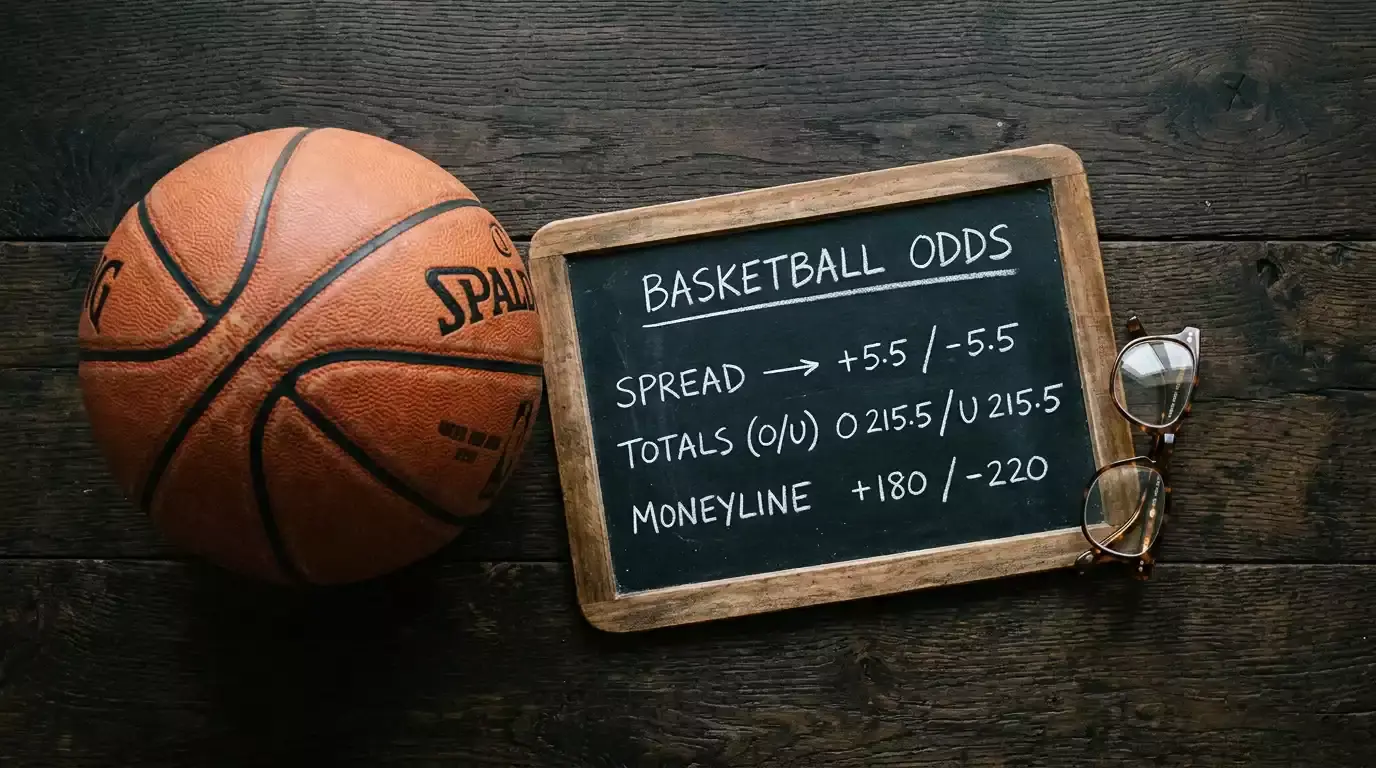
Handicap – The UK equivalent of the American point spread. A team given a -5.5 handicap must win by six or more points for the bet to win. A team on a +5.5 handicap can lose by up to five points and still cover.
In-Play (Live Betting) – Betting on an NBA game after it has started. In-play wagering now represents more than 62 per cent of online betting revenue in the US market and continues to grow at a compound annual rate approaching 14 per cent. UK bookmakers use “in-play” rather than the American “live betting.”
Moneyline – A bet on which team will win the game outright, with no spread involved. The American term is used universally, including at UK bookmakers. Also called “match winner” at some UK operators.
Overround (Vig, Juice) – The bookmaker’s built-in margin. If the implied probabilities of all outcomes in a market sum to more than 100 per cent, the excess is the overround. A market with 104 per cent total implied probability has a 4 per cent overround. Americans call this “vig” or “juice”; UK bettors should look for it as the overround.
Punter – The UK term for a bettor. In American sports betting parlance, the equivalent is “bettor” or “handicapper.”
Totals (Over/Under) – A bet on the combined final score of both teams. The bookmaker sets a line (e.g. 221.5), and you bet whether the actual total will be over or under that number.
Strategy and Analytics Terms Every NBA Bettor Should Know
Closing Line Value (CLV) – The difference between the odds you took when you placed your bet and the odds available at tip-off. If you bet a spread at -3.5 and it closes at -5, you captured positive CLV. Consistently beating the closing line is the strongest indicator of long-term betting skill.
Defensive Rating – Points allowed per 100 possessions. A lower number indicates better defence. This metric is more useful for totals analysis than raw points allowed because it adjusts for pace.
Edge – The difference between your assessed probability of an outcome and the implied probability of the bookmaker’s odds. If you believe a team has a 60 per cent chance of covering the spread but the odds imply 52 per cent, you have an 8 per cent edge.
Expected Value (EV, +EV) – The average profit or loss per bet if the same wager were placed infinitely. A +EV bet is one where your expected return exceeds your stake over the long term. All serious betting strategy aims to identify +EV opportunities.
Fade – To bet against. “Fading the public” means betting on the side that the majority of recreational bettors are not backing, on the theory that public money creates mispricing.
Line Movement – The change in a spread, total, or odds price between the opening number and the closing number at tip-off. Movement is driven by money flow, injury news, and sharp bettor activity.
Pace – The number of possessions a team uses per 48 minutes. Higher pace means more possessions, more shot attempts, and typically more combined scoring – directly relevant to totals betting.
Sharp – A professional or highly skilled bettor whose action moves lines. When sharp money hits a market, bookmakers adjust the odds in response. The opposite is “square” or “public” money. Christopher Hebert, Chairman of the Louisiana Gaming Control Board, has emphasised the importance of regulators listening when sports bodies raise integrity concerns – and sharp bettors are often the first to identify suspicious line movements that signal potential problems.
Steam Move – A sudden, significant line movement caused by coordinated sharp action across multiple bookmakers simultaneously. Steam moves indicate high-confidence professional betting activity.
Unit – A standardised measure of bet size, typically 1 to 3 per cent of your total bankroll. Using units rather than fixed pound amounts allows you to compare performance across different bankroll sizes and adjust stakes as your bankroll grows or shrinks.
Regulation and Responsible Gambling Terms
Affordability Check – A UK-specific regulatory requirement introduced by the Gambling Commission. Bookmakers must monitor customer losses and conduct enhanced due diligence when spending reaches certain thresholds. The check may require documentation such as proof of income or bank statements.
GAMSTOP – The UK’s free national self-exclusion scheme. Registering with GAMSTOP blocks your access to all UKGC-licensed online gambling operators for a minimum of six months.
GamCare – The UK’s primary free support service for people affected by problem gambling. Offers a helpline, live chat, and face-to-face counselling nationwide.
Self-Exclusion – A voluntary measure where you ask a bookmaker to close your account for a specified period. Can be done with individual operators or across all licensed platforms via GAMSTOP.
UKGC (UK Gambling Commission) – The regulatory body responsible for licensing and overseeing all commercial gambling in Great Britain. All bookmakers offering NBA betting to UK residents must hold a UKGC licence.